
About Our Onions
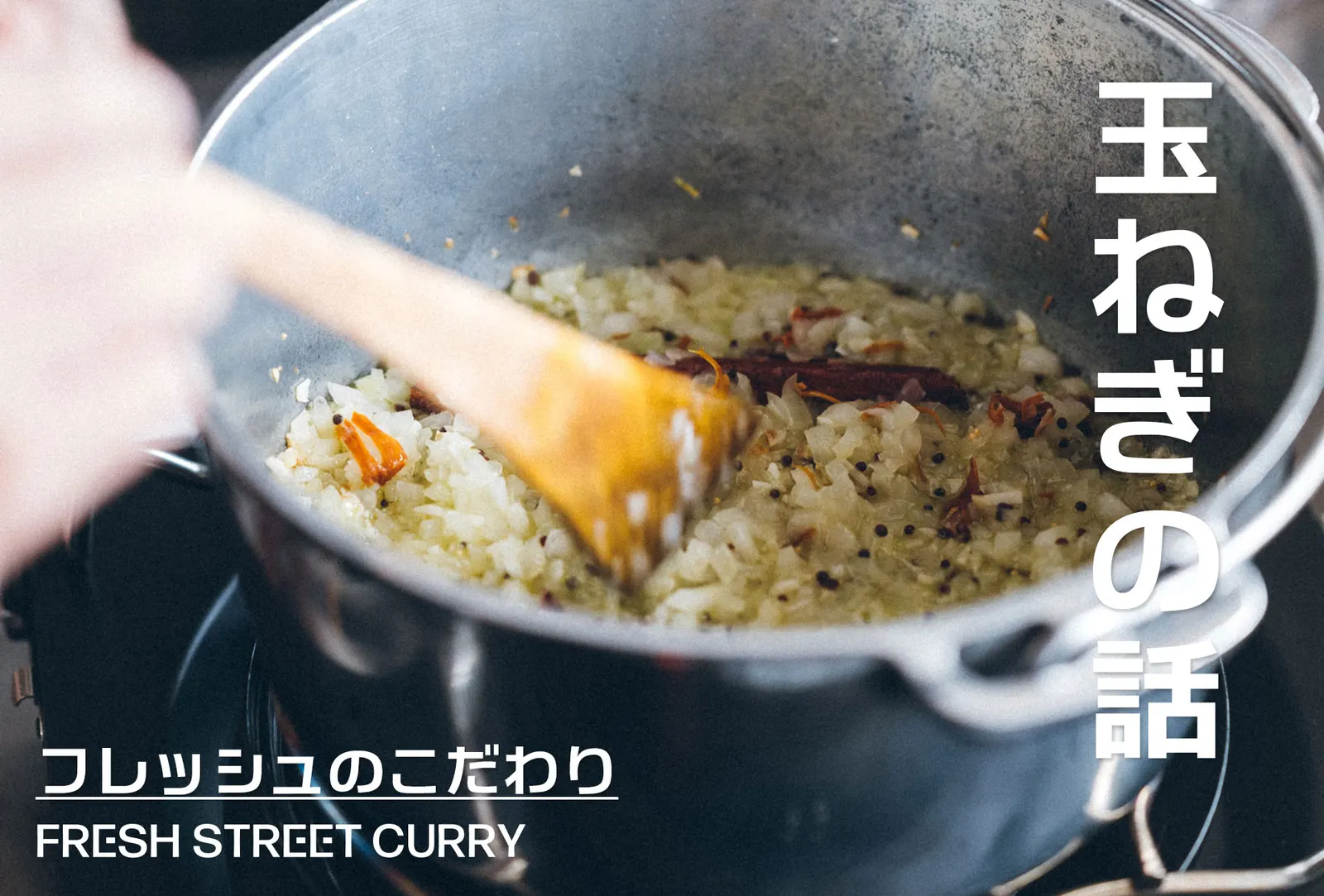
Spices are essential to making delicious curry. And onions.
How onions are cooked determines the depth, sweetness, and overall umami of the roux—it's almost an understatement. During Fresh Street Curry's roux development, the one thing we spent the most time testing and refining was onion preparation.
Three major factors affect the outcome: "how the onions are cut," "cooking temperature," and "cooking time (dehydration)." Today, I'd like to share Fresh Street's approach to the cutting method.
"What's the best way to cut onions for delicious curry?"
・Minced
・Wedge-cut
・Halved or quartered
・Whole, uncut
Some say "the best approach is to barely cut the onion and simmer it slowly in water at low temperature," while others argue "the finer you mince them, the better." There are many interpretations and perspectives.
Our development team at Fresh Street Curry tried all these patterns, observing how flavors changed. Especially with large-batch cooking in stockpots, the difference in taste from different cutting methods is dramatic. Even with identical ingredients, heat, and cooking steps, you get completely different curries. At Fresh Street Curry, we prioritize approaching cooking through scientific insight and logic, not just intuition.
To get straight to the point: Fresh Street uses two methods—mincing very fine, almost to a paste, and quartering into wedges. After simmering these in water to achieve optimal dehydration, we raise the temperature to where the Maillard reaction occurs, then sauté until we achieve the desired sweetness and depth.
Just sautéing onions releases an appetite-stimulating aroma you'd never get from sniffing raw onions for hours. That's because heat changes the compounds in onions, but the cutting method actually changes how much of each compound is produced.
When you mince an onion, countless cells break open, releasing an enzyme called alliinase. This enzyme reacts with isoalliin in the onion, generating "propanal-S-oxide (PSO)."
(PSO's tear-inducing effect is why you cry when cutting onions.)
When onions containing PSO are heated at low temperature, they transform into "3-mercapto-2-methylpentane-1-ol (MMP)," creating rich aroma. Interestingly, "quartered wedges" produce almost no PSO. (Imagine cutting an onion into quarters—your eyes usually don't sting at all.)
So why do we use both minced onions and quartered wedges? The answer: "to produce sugar, enhance sweetness, and build depth." We discovered that to extract sweetness from onions, it's best to heat them with minimal cutting, keeping them closer to their original shape.
A: Minced onions alone = [Aroma ◎ Sweetness ×]
B: Quartered wedges alone = [Aroma △ Sweetness ◎]
So we combined A and B in a 1:3 ratio, and this officially became the roux formula for Fresh Street Curry you enjoy today.
Here's hoping today brings good curry weather.
FRESH STREET CURRY